Architecture
memFrame is a thin pandas-like API over a database engine. Every DataFrame-style call is compiled to backend-native SQL and executed in-engine — your data never leaves the database. The call path is a four-layer stack, with connection, ingestion, and cache as cross-cutting subsystems, and an optional AI agent layer on top.
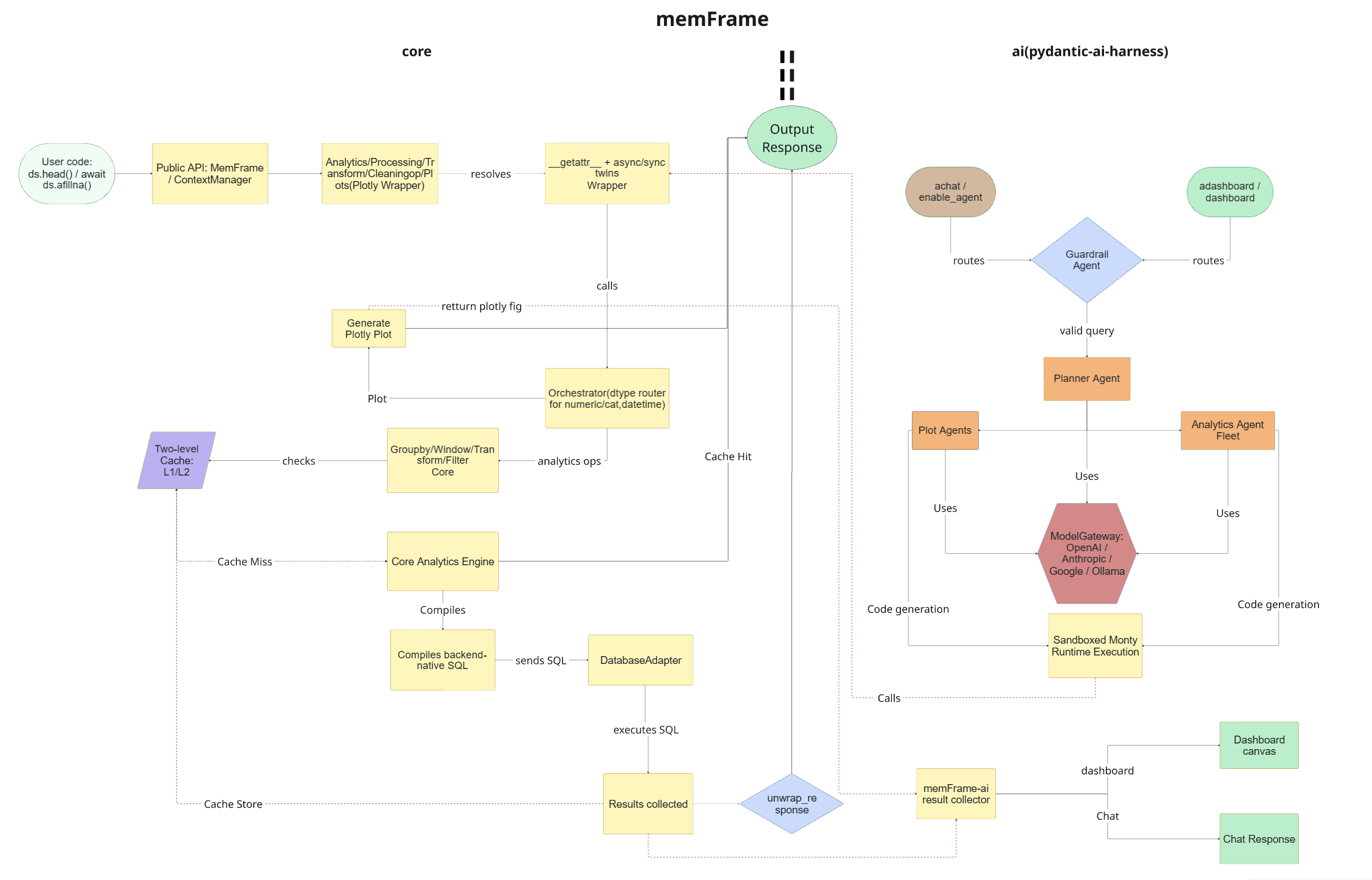
Layers
- Public API —
MemFrameand the per-datasetContextManagerit returns after upload.ContextManager.__getattr__lazily resolves any method onto a wrapper; each wrapper exposes anasync/synctwin (ahead/head) and delegates viasuper(). - Orchestration — the
*Orchestratorresolves the activedata_idto atable_name,schema(DuckDB/PostgreSQL) ordatabase(ClickHouse) from thememframe_csv_registry, lazily builds the core ops engine, and applies the@record_calltwo-level cache. - Core engine —
GeneralTableOpsbuilds and runs the backend-native SQL, returning a structured{is_error, result, ...}envelope;unwrap_responseraises on error or returns the raw result. Plotting mirrors this with*PlotCore. - Adapter —
DatabaseAdapteris the only place that knows placeholder style (?vs$1), identifier quoting, and metadata queries, per backend.
Cross-cutting subsystems
- Connection —
ConnectorManagerowns the lifecycle: connection pool, theDatabaseBackend(createsmemframe_csv_registry/memframe_transient_registry— schemas on DuckDB/PostgreSQL, databases on ClickHouse — and runs migrations), and the uploader. - Ingestion — upload strategies for CSV / Parquet / pandas DataFrame plus a
DatatypeDetector(encoding, delimiter, type inference). - Cache —
record_callis aCacheManagerdecorator. L1 (deep_cache=False, default) records call signatures as a lineage/audit log only; L2 (deep_cache=True) persists result DataFrames as typed transient tables and replays them on a hit.
Optional AI layer (memframe_ai)
MemFrame.aenable_agent / ContextManager.achat route natural-language prompts
through entrypoints into a fleet of Pydantic-AI agents. A GuardrailAgent
runs first and validates the prompt against the active table's columns (rebuilt
per query via build_domain_context); cross-dataset or off-topic requests are
rejected gracefully — chat() returns a refusal answer and adashboard() returns
a styled HTML page, never an exception. Toggle it with
AISettings(guardrails_enabled=False) (default on; fail-open on guardrail errors).
A PlannerAgent then decomposes the accepted prompt into a typed SubQueryPlan,
and AnalyticsAgent specialists (inspect, select, clean, stats, arithmetic,
plots) execute each sub-query by calling the same core ops engine the API
uses. ModelGateway maps a provider to a Pydantic-AI model (OpenAI, Anthropic,
Google, Ollama), with FallbackModel support.
For visualization, ContextManager.adashboard() / dashboard() collapse the
whole flow into one call: they reuse achat() on the active dataset, harvest
the returned results and plots, and feed them to DashboardManager, which renders
a single full-screen Plotly figure ("canvas") of subplot widgets. Only compact
summaries (shape, columns, 2-row sample, capped Plotly spec) reach the dashboard
LLM — never raw data values. The entire pipeline is opt-in Logfire-instrumentable
(see the agent docs): every agent run, LLM call, and tool call is traced, plus a
top-level request span.